Professional Tree Health Assessments: A Homeowner's Guide

Last Updated: October 22, 2026
Quick Summary
Professional tree health assessments are comprehensive evaluations of your trees' structural integrity, disease status, pest infestations, and overall condition performed by a certified arborist. These assessments prevent costly damage, protect your family's safety, and preserve your landscape's long-term health by catching issues before they become emergencies.
Early detection of disease and pest problems invisible to the untrained eye can prevent advanced damage.
Structural failure prevention identifies hazards like internal decay and poor branch attachment before they threaten your home.
Low-risk mature healthy trees need assessment every 3-5 years; moderate-risk trees annually; high-risk trees every 6-12 months.
Assessment reports document tree condition, risk ratings, and prioritized recommendations to guide your care decisions.
Post-storm assessments and event-driven checks should override routine schedules when construction, damage, or changes occur.
Table of Contents
Why Professional Tree Health Assessments Matter for Your Property
What a Certified Arborist Tree Inspection Includes
Visual Inspection of Structural Integrity
Disease and Pest Detection
Understanding Tree Risk Assessment and Hazard Identification
The three components of tree risk
Levels of assessment: what each one can and cannot tell you
What a visual assessment can and cannot establish
Turning risk findings into decisions
Recognizing Signs of an Unhealthy Tree
How Often to Inspect Trees for Early Problem Detection
Routine reassessment intervals
Event-driven reassessment: when the calendar should not wait
Monitoring versus reassessment
Seasonal timing and what it changes
Building reassessment into your tree care plan
What to Expect During a Professional Assessment
Assessment Reports and Creating Your Tree Care Plan
Frequently Asked Questions
Why Professional Tree Health Assessments Matter for Your Property
A professional tree health assessment is a comprehensive evaluation of your trees' structural integrity, disease status, pest infestations, and overall condition, performed by a certified arborist. These assessments prevent costly damage, protect your family's safety, and preserve your landscape's long-term health.
Most homeowners don't think about their trees until something goes wrong, a branch falls, leaves drop prematurely, bark peels. By then, the problem has often advanced beyond what early intervention could have prevented.
Here's what makes assessments critical for property owners:
Early detection of disease and pest problems, Many diseases and infestations are invisible to the untrained eye early on. A certified arborist knows where to look and what symptoms signal trouble.
Structural failure prevention, Trees with internal decay, root damage, or poor branch attachment can fail without warning. Professional inspection identifies these hazards before they threaten your home or family.
Informed decision-making, Rather than guessing whether a tree needs pruning, removal, or treatment, you'll have a documented assessment to guide your choices.
Property value protection, Well-maintained trees enhance curb appeal and property value. Hazardous or diseased trees do the opposite.
Compliance with local regulations, Some municipalities require documented tree assessments for development projects or right-of-way clearance. A professional assessment creates the documentation you need.
What a Certified Arborist Tree Inspection Includes
Visual Inspection of Structural Integrity
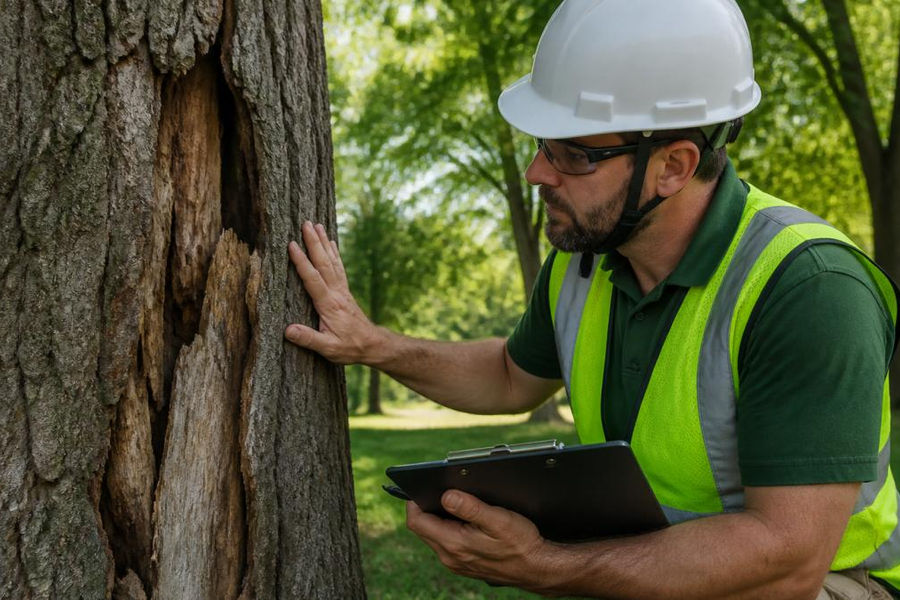
The inspection also checks for lean or unusual growth patterns, which may signal compromised roots or structural weakness, and evaluates the crown for density, symmetry, and signs of dieback or deadwood.
Root health matters equally. The arborist examines the visible root collar for girdling roots, root damage, soil compaction, or poor drainage that could stress the tree's foundation.
Disease and Pest Detection
A certified arborist knows the diseases and pests that threaten trees in your region.
Common diseases include anthracnose (leaf spotting and twig dieback), Dutch elm disease (sudden wilting and death), and root rots that weaken the tree from below.
The arborist also assesses overall vigor and growth rate; slow growth, sparse foliage, or stunted leaves can indicate disease, pest stress, or environmental problems like poor drainage or soil compaction.
Understanding Tree Risk Assessment and Hazard Identification
A tree risk assessment goes beyond general health evaluation to identify specific hazards. Where a health assessment asks "what condition is this tree in," a risk assessment asks "what could fail, how likely is it, and what would it hit." The two overlap but answer different questions.
The three components of tree risk
Most professional risk assessments follow a framework built on three inputs:
Target identification. What is within striking distance? A house, deck, parked car, fence, sidewalk, utility line, or person. The closer and more valuable the target, and the more time people spend there, the higher the consequence of failure. A dead limb over an empty lot corner differs from the same limb over a child's play set.
Likelihood of failure. Does the tree have defects, disease, or pest damage raising the probability of failure? A sound tree with good branch attachment poses minimal risk; one with internal decay, codominant stems, or severed roots is a higher concern. Likelihood is usually expressed as a range (improbable, possible, likely, imminent), because no one can predict failure with certainty.
Consequences of failure. If a branch or the entire tree fails, what damage could result? A small dead branch falling on grass is low consequence. A large limb failing onto a roof, a vehicle, or a walkway is high consequence.
The assessor combines these inputs into an overall risk rating, typically low, moderate, or high, and explains the reasoning. That explanation matters as much as the label: it tells you which factor drives the risk and which mitigation will actually help.
Levels of assessment: what each one can and cannot tell you
Not every tree needs the same depth of inspection. Understanding the progression of assessment levels helps you judge whether a proposal is appropriately scoped.
Level 1, Limited visual assessment. A walk-by or drive-by look at many trees at once to flag obvious problems and decide which warrant a closer look.
Level 2, Basic visual assessment. A ground-level, 360-degree inspection of an individual tree, often with binoculars and hand tools.
Pro Tip Ask which level of assessment you are paying for. A proposal that says only "tree inspection" is ambiguous; a proposal that specifies a Level 2 basic visual assessment (or explains why a Level 3 advanced assessment is warranted) tells you what you are actually getting.
What a visual assessment can and cannot establish
A basic visual assessment is powerful but has real limits, and a good assessor will say so. It can document visible defects, describe crown condition, identify many disease and pest symptoms, and rate risk based on what is observable.
That uncertainty is a reason to read the report carefully, not skip the assessment. "Moderate risk, possible failure, high-consequence target" means the tree deserves mitigation or monitoring even though no one can promise it will fail.
Turning risk findings into decisions
Once the risk rating is in hand, the assessor should walk you through the options: prune the defective limb, install support cables or braces, treat a pest or disease, reduce the target (move a parked car, reroute a path), monitor and reassess, or remove the tree. Each carries a different cost, timeline, and residual risk. The right choice depends on how the three risk components combine, which is why a rating without reasoning is hard to act on.
Recognizing Signs of an Unhealthy Tree
Learning to spot signs of an unhealthy tree helps you decide when to call for a professional assessment. Some indicators are obvious; others are subtle but significant.
Visible warning signs include:
Dead or dying branches throughout the canopy (not just the outer tips)
Bare patches or significant canopy thinning
Leaves that are smaller than normal, discolored, or dropping early in the season
Subtle but serious signs:
Slow growth or lack of new shoots
Leaves with unusual spots, yellowing, or wilting despite adequate water
Changes in growth pattern year to year
Not every warning sign means the tree is doomed. A tree with minor deadwood and some leaf spots may recover with proper care; one with major structural defects and advanced disease likely needs removal.
How Often to Inspect Trees for Early Problem Detection
The right reassessment schedule follows from the tree's risk rating, species, age, and surroundings. A low-risk tree with no defects can wait years between assessments; a moderate- or high-risk tree, or one near a high-consequence target, needs closer monitoring. Treat the intervals below as starting points to discuss with your arborist, not fixed rules.
Routine reassessment intervals
Low-risk, mature, healthy trees: a basic visual assessment every 3-5 years is a common baseline. Many practitioners stretch this for sound, slow-growing species in low-traffic areas.
Older trees (roughly 40+ years): every 2-3 years, because decline and defect accumulation tend to accelerate with age.
Trees rated moderate risk: annually, or as the report specifies, so the assessor can confirm whether the defect is stable or progressing.
Event-driven reassessment: when the calendar should not wait
Some triggers override the routine schedule. Schedule an assessment promptly after:
Storms, ice, heavy snow, or high winds that may have cracked limbs, loosened roots, or shifted the tree's lean. Storm damage often sets the stage for later decay and pest problems, so a post-storm check is both a safety measure and an early-warning step.
Construction, grading, trenching, or paving near a tree. Root damage and soil compaction from nearby work can take months or years to show above ground, so an assessment before and after the work is wise.
Changes you notice yourself, new lean, mushrooms at the base, bark cracking, a suddenly thinning canopy, or sawdust at the trunk. These are reasons to move up the next assessment, not wait for it.
Monitoring versus reassessment
Monitoring is not the same as a full reassessment. A monitoring plan is a lighter, more frequent check focused on a specific defect, for example, watching a crack for expansion, photographing a lean over time, or checking whether a treated pest infestation is receding. The assessment report should state what to monitor, how often, and what change would trigger a full reassessment or immediate action.
Watch Out Do not let a "low risk" rating become a reason to stop looking. Risk ratings describe conditions at the time of assessment; trees change, storms happen, and nearby construction can alter the picture. A reassessment schedule exists precisely because the rating is a snapshot, not a permanent label.
Seasonal timing and what it changes
Late fall or early spring, when deciduous trees are dormant and bare, makes structural defects easier to see and is a practical time for routine assessments. But timing is secondary to need: a suspected hazard should be assessed whenever it is noticed, and some problems, active pest infestations, summer storm damage, fungal fruiting bodies, are best evaluated in the season they appear.
Building reassessment into your tree care plan
The assessment report should recommend a reassessment interval and list the specific triggers that warrant an earlier visit. Put those dates and triggers somewhere you will see them, a calendar reminder, a note with your property records, or a line in your tree care plan. When you sell the property or file an insurance claim, a documented history of routine assessments and follow-through is far more useful than a single inspection from years ago.
What to Expect During a Professional Assessment
Understanding what happens during a professional tree health assessment removes uncertainty and helps you prepare. Here's the typical process:
Before arrival: Provide clear access to your trees and note any specific concerns (a branch you're worried about, recent damage, or changes you've noticed).
Initial walkthrough: The arborist walks your property to identify all trees and get an overview of their condition.
Individual tree inspection: For each tree of concern, the arborist examines the trunk, branches, canopy, and root zone.
Discussion: The arborist explains their findings in plain language, pointing out specific issues and what they mean.
The entire process typically takes 30-60 minutes per tree, depending on size and complexity.
Assessment Reports and Creating Your Tree Care Plan
A professional tree health assessment results in a detailed report that becomes your roadmap for tree care decisions.
A strong assessment report includes:
Tree inventory, Species, approximate age, size, and location of each tree evaluated
Condition summary, Overall health rating, structural integrity assessment, and crown condition
Specific findings, Documented diseases, pest infestations, structural defects, and hazards
Use the report to create your tree care plan. Prioritize recommendations by urgency and budget.
Many homeowners find it helpful to share the assessment report with multiple tree care providers before getting estimates.
Professional tree health assessments are an investment in your property's safety, beauty, and long-term value.
Frequently Asked Questions
What does a professional tree health assessment include?
A professional tree health assessment examines the tree's overall condition through visual inspection of the trunk, branches, roots, and canopy. A certified arborist evaluates structural integrity, identifies signs of disease or pest infestation, assesses growth patterns, and evaluates how site conditions affect the tree. The assessment also identifies hazardous branches or structural weaknesses that could lead to tree failure and result in property damage or personal injury.
How often should you schedule a tree health assessment?
Most homeowners should have mature trees inspected every 2-3 years as part of preventive maintenance. Trees near structures, those showing visible decline, or trees that have experienced storm damage should be assessed more frequently, sometimes annually. After severe weather events, schedule an inspection immediately to identify any new hazards or damage that could threaten your property.
Can a tree health assessment identify disease or pest problems?
Yes. A certified arborist can detect many fungal diseases, pest infestations, and other health issues during a visual inspection by looking for specific symptoms like discolored leaves, canopy dieback, unusual bark texture, or visible pest damage. Early detection of disease or pest problems allows for treatment options that may preserve the tree, preventing the need for removal and protecting surrounding landscape health.
What is the difference between a tree health assessment and a tree risk assessment?
A tree health assessment focuses on the overall condition of the tree, its vitality, disease status, and growth patterns. A tree risk assessment evaluates whether the tree poses a hazard to your property or safety, identifying structural weaknesses, deadwood, or failure risks. Many professional assessments include both elements, giving you a complete picture of the tree's health and any potential risks it presents.
Call or Text for estimate
Add andersontreecareiowa.com as a preferred source on Google →

Comments